
Often as a turn-key solutions provider taking specifications often as brief as an itemized list on an A4 sheet of paper. I have acted in many roles, as project manager, design engineer, software developer, test an validation engineer and production engineer. Diligently working behind the scenes to make customer dreams come true.
I have designed, developed electronic products, managed budgets, resources such as workshop and technicians, external contractors along with customer expectations through direct dialog and continuous cooperation in the development among others, the following electronic products.
The Nano Particle Generator Filter
This is a mixed signal, Analog and Digital signal processing engine used as part of a Spectroscopy equipment for deposition of nano particles in a controlled chamber environment. It is based on the principle of Quadrupole Mass Spectroscopy.
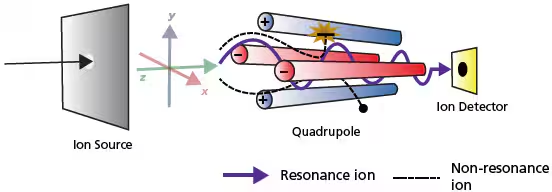
From an electronic engineering perspective, we are looking at a signal processing engine with numerous input and output ports and a range of circuits to generate a pair of high voltage AC waveforms based upon real time input parameters such as Amplitude, Frequency and DC Offset from a terminal connected to its’ USB port. Ultimately to generate two Sinusoids across a pair of rods.
You can view this product at customer’s web portal at: Nano Technology Limited
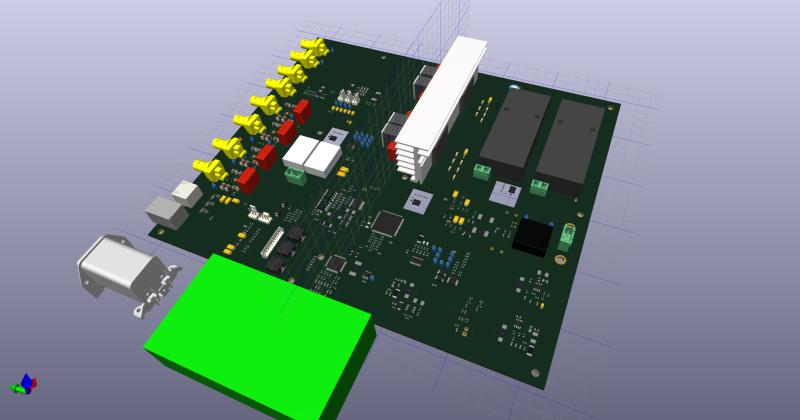
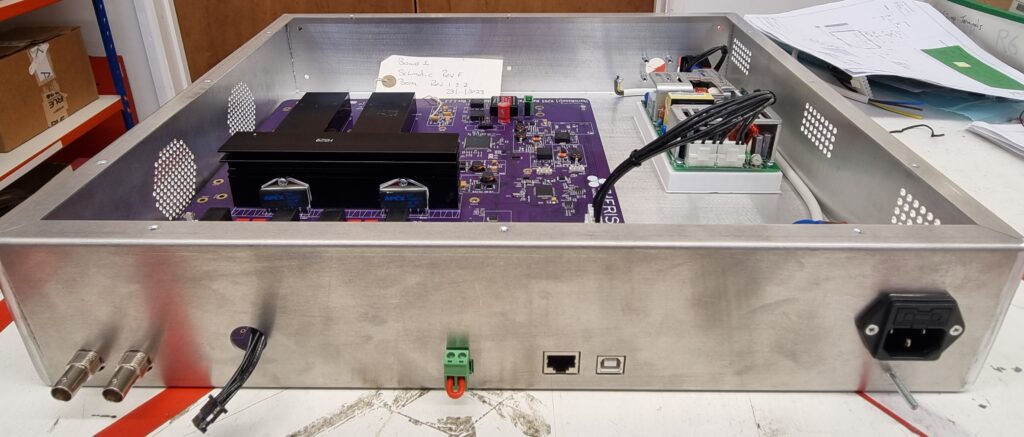
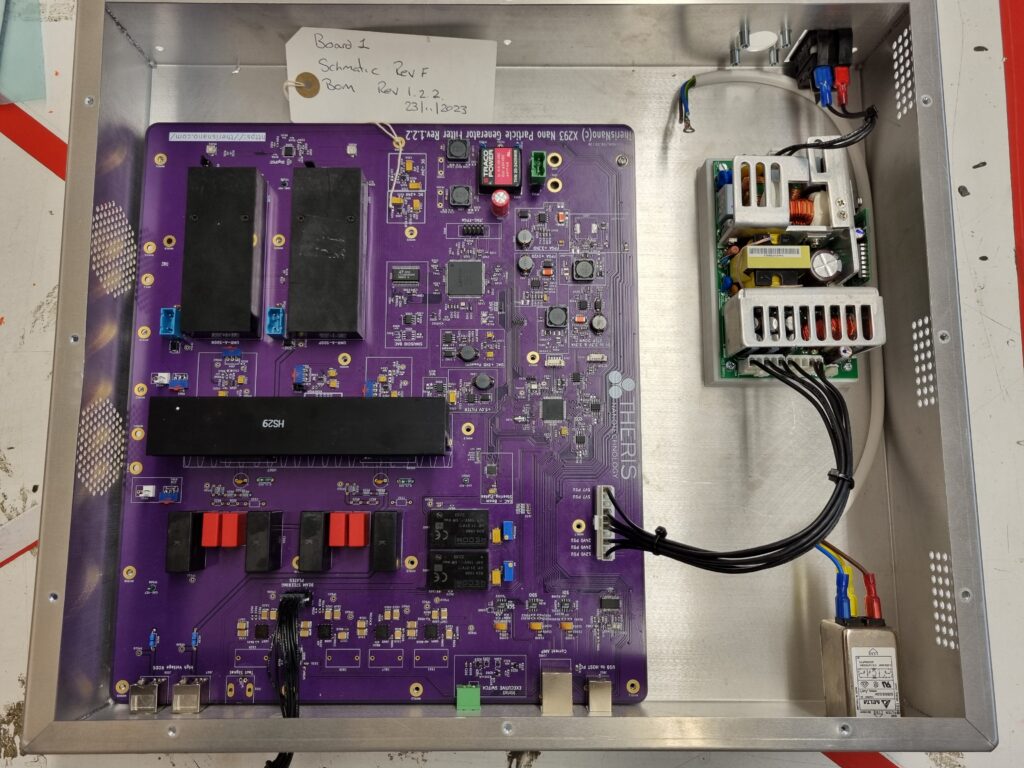
The Nano Particle Generator filter is a highly integrated hybrid electronic design for a classic Quadrupole Mass Spectroscopy , comprising of a nano Current Amplifier with dynamically programmable parameters, built around a pair of Dean-Tech power supplies and a pair of Apex Power Operational Amplifiers .
Early Prototypes
BLE | Bluetooth Low Energy | IoT | M2M | Remote Ball Valve Controller
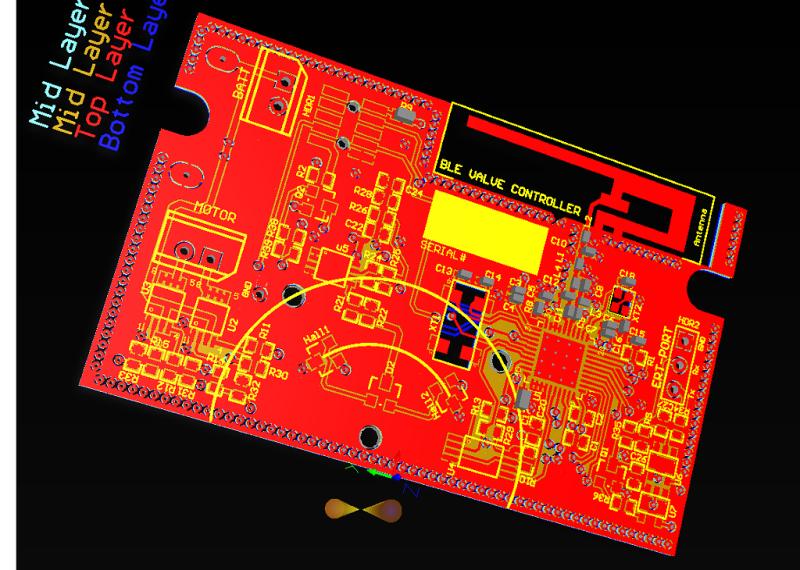
Illustration of early PCB layout (3D view in Altium Designer).
Note the two hall sensors that are 30-degreees apart along the yellow arcs. These are positioned relative to the DC motor beneath the PCB, which is used to turn the ball valve to open and close the aperture to increase or decrease the flow of water. This is done through signal conditioning of the hall-effect sensors, which are sampled though an on-board ADC. Whilst this is a common technique, what’s lever about this application is the positioning of the hall-sensors since the relative magnitude of readings from the two sensors give us a fairly accurate indication of absolute position of the ball-valve.
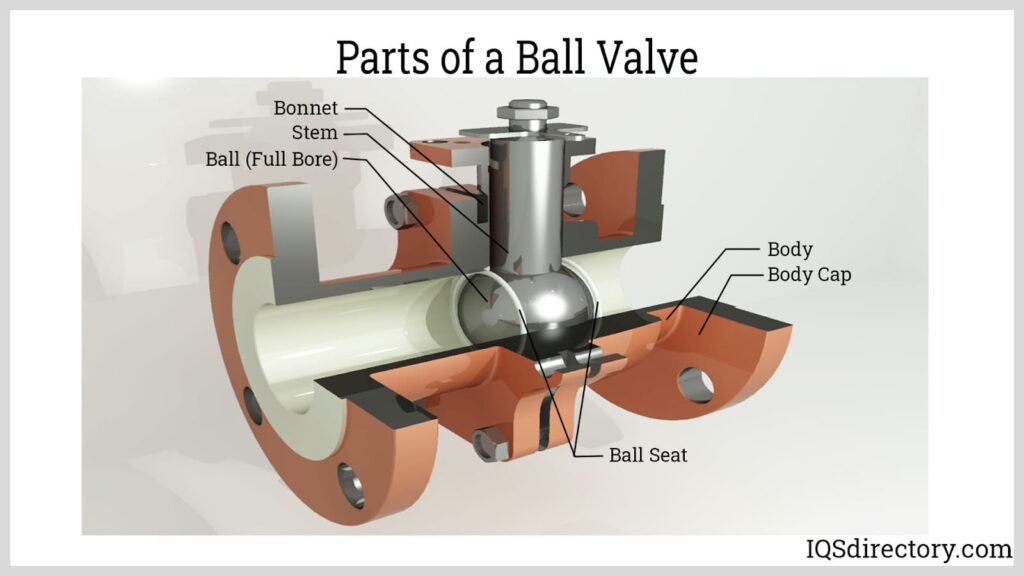
If you’re wondering what’s a ball valve… Here’s a cross sectional view of what one looks like.. Not that the ‘ball’ is bored in one axis and it is the action of turning it in the z-direction that changes the aperture.
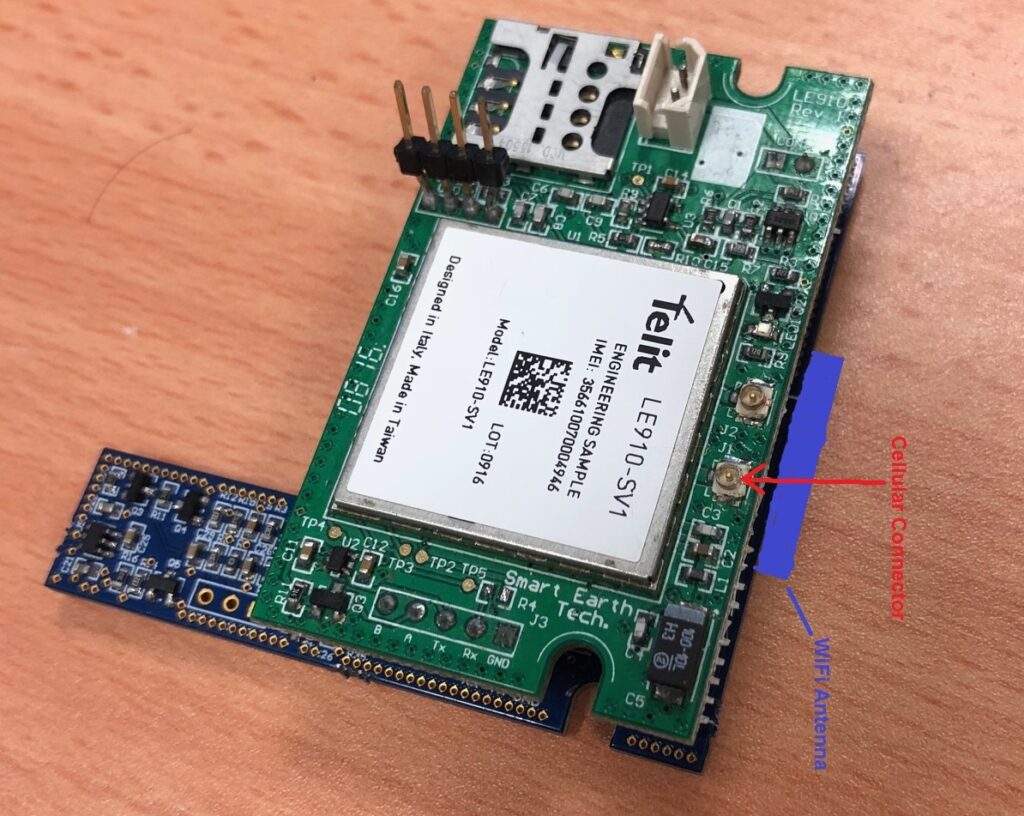
The integral Inverted-F antenna for 2.4GHz Bluetooth operation. A second 50 Ohm external antenna was integrated in subsequent designs through the addition of a SMA header to the PCB for 3G M2M communications such that commands could be sent to the unit by way of coded SMS Messages to operate and interrogate the Valve system.
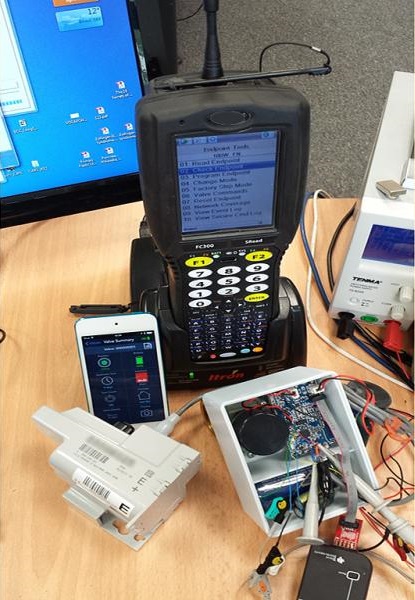
This photograph shows my desk with an early prototype and representative equipment it needed to communicate with such as an iPod running the Controller App, the Sensus module an hand-held authorization terminal and the TI Debugger tool with probes connected to an oscilloscope for testing and debugging, forming a realistic validation scenario with actual equipment that the solution is intended to be used with.
Texas Instruments TI2540 SoC and BT Stack based BLE (Bluetooth Low Energy) unit uses the 8051 Microcontroller Core, which at the time of this design ticked all the right boxes against requirements of this product. M2M or 3G (later 4G LTE) communications solution through thee integration of a Telit LTE Module
At the heart of this product is a DC motor that is driven by a H-Bridge circuit and a neodymium magnets embedded inside the motor enclosure and paired with two hall sensors. In this instance on the 4-layer PCB as position sensing topology with bidirectional drive mechanism. Firmware was developed in C++ using IAR EWB toolchain and based on Texas Instruments BLE Stack, appropriate Bluetooth Profiles were chosen for each element, that is the App running on a Smartphone device and the IoT Valve itself..
In principle, this solution allowed a mechanical ball-valve to be controlled over a Blutooth radio link via an App running on a Smartphone, or remotely using encrypted SMS commands via the GSM/LTE module sent from a remote central control center . Note that Over-the-Air firmware updates was also developed in the Smartphone App which has become standard for all Smartphone Apps today.
Water Leak Detector – EMS1
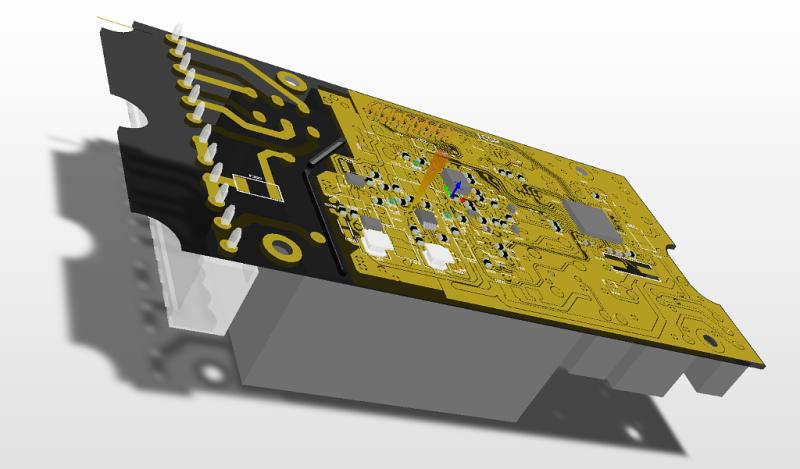
Here we are taking a final look at the internals of a Sensor based water leak detection unit. Based on requirements, the physical envelope of this solution is a dual mains outlet socket. More details about this product can be found at client web-site at Aqualeak’s web pages.
The EMS-1 is an industrial leak detection system. It includes a simple three button touch-sensor operating panel with three RGB LEDs to configure and communicate operating status of the unit in conjunction with audible alarm. It works from a 240V Mains input supply. Two relays aree incorporated to drive external equipment during fault consitions. With sensor ports connecting to a mixture of Analog and Digital electronic circuits through an 8-Bit microcontroller, moisture and leak detection is carried out continuously in real time. Two distinct regions on the two layer PCB include careful isolation considerations for creepage and clearance between Mains AC and Low Voltagee DC circuit elements.
Professional Audio Interface DSP / Embedded-Linux
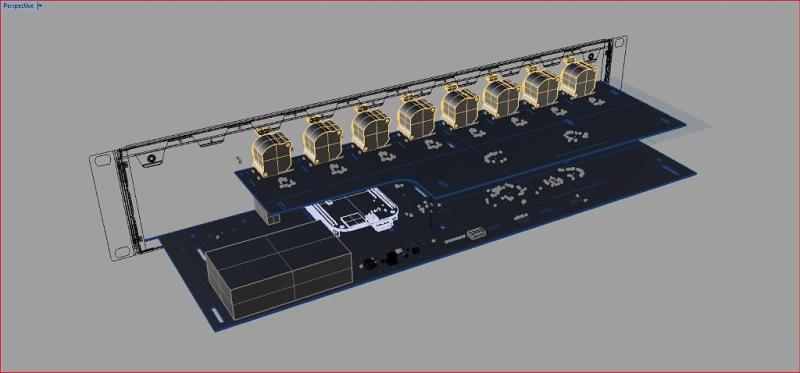
Embedded Linux audio DSP application housed in a 2U case. Images below show Altium STEP file integrated with enclosure drawings to ascertain cut-out positions for connectors. The electronics is made up of two stacked PC boards, with the lower carrying a Beaglebone SBC, AC/DC converter and dc/dc converters and upper PCB comprising of another bank of XLR connectors.
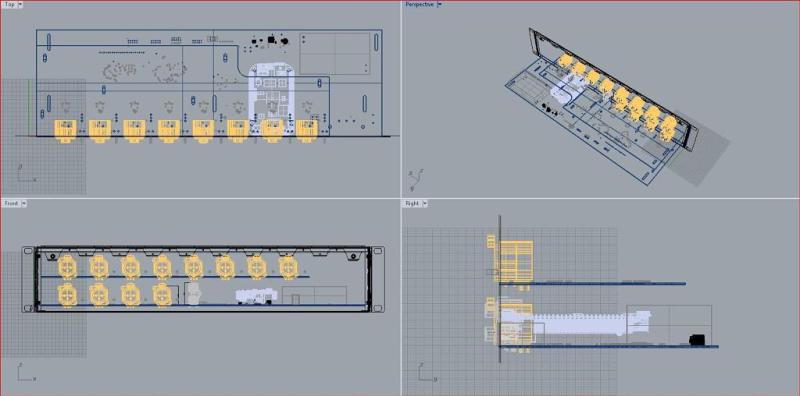
Professional Audio Interface / CAD
These drawings represent CAD work and mechanical engineering efforts to align and bring together two large PCBs into a 2U rack-mountable 19inch enclosure, sandwiching the electronics, with numerous industry standard connectors to the front and back of the unit, including RJ45 for remote access via SSH (into Linux) through the Beaglebone SBC.
Analog Devices SigmaStudio (LabView like GUI DSP Configurator)
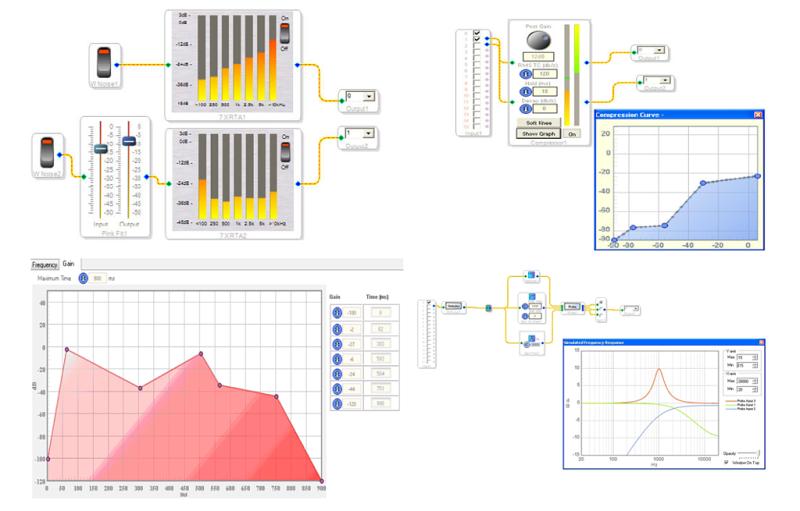
This image illustrates Sigma-Studio design environment.
With twelve microphone channels, the X246 project utilizes Analog CODEC IC’s to convert signals from each channel into a digital audio stream, in this case in the form of I2S. Sigma-Studio is a feature rich DSP platform that provisions sequencing, routing and adding desirable DSP effects to our signals. The ADAU1452 is ideally designed with a non volatile EEPROM where configurations may be stored and read back following power cycles.
DJ Media Stramer
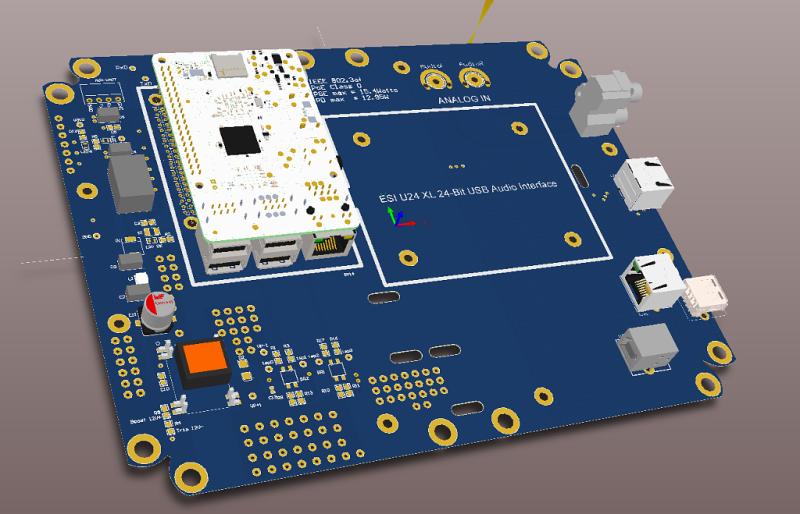
PoE | Media Streamer | Power Over Ethernet | IEEE 802.3af | eLinux | Embedded Linux |
This Embedded-Linux platform provisioned our client with a solution to stream audio to Facebook without the need for external power supplies. In the illustration above, the orange cube in the bottom left hand sided of the board is part of the Class 4 PD PoE injector magnetics module. It generates up to 13 Watts of power to energise the whole system eliminating the need for external power.
This design comprises of a Raspberry-Pi SBC running Linux OS an scripts to interface with Facebook API’s. A modular ESi U24 XL Audio Interface with 24Bit AD/DA converters is integrated to accept 2 x Analog input and 2 Analog output channels (1/4″ TRS connectors) – The ESI is supported by Cubasis LE software . .
| Telemetry | RF +20dBm 868MHz | Temporary Traffic Lights |
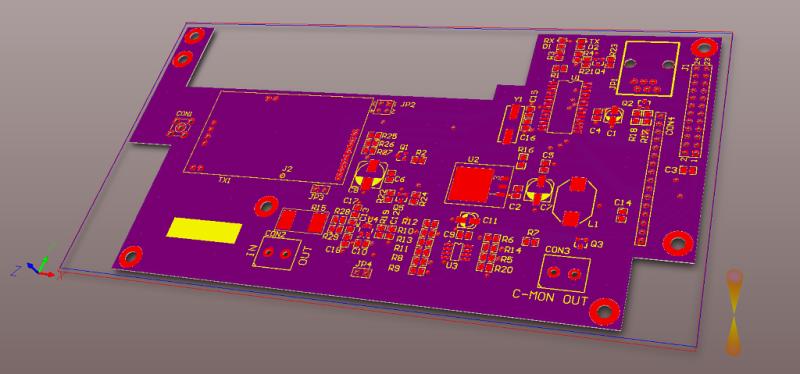
RF Transceiver unit forms part of a radio controlled temporary traffic-light management system for roadworks on highways for UK client formerly known as Pike | Telemetry | Signals.
POS | Point of Sale | In-Flight | Scanner | Printer | WiFi | GSM | USB 2.0
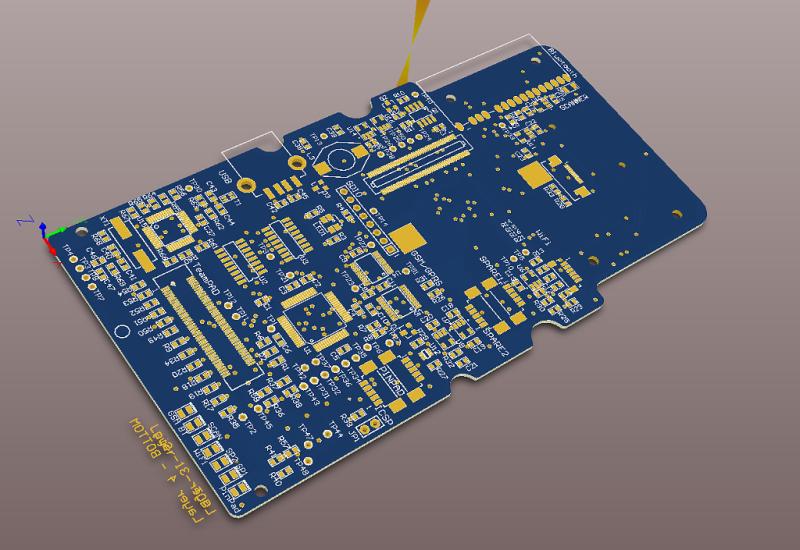
A pre Cloud era project circa. 2007 (Customers know best and your job is to deliver what they want). This handheld expansion board was used to adapt a low cost PDA to extend features and meet requirements of an In Flight Sales terminal of its day. The HP iPAQ Pocket PC was a line of personal digital assistants (PDAs) running on Microsoft’s Pocket PC (Windows Mobile) operating system.
This In-Flight Point of Sale system extended the IPAQ’s features with a bar code Scanner, receipt Printer interface, USB 2.0, Wifi and GSM integration to transfer in-flight sales reports to a base computer following touchdown by the aircraft for post-processing.. This was for a Bristol based UK client, formerly known as Bristol Office Machines
The following is a selection of former clients whose products I have designed, with links to actual products
NanoTechnology Limited https://therisnano.com
Dyson https://www.dyson.co.uk/vacuum-cleaners/cordless/hyperdymium-motor
Aqualeak Detection Limited https://aqualeak.com
Pirate Studios https://pirate.com/en/recording-studios/
Hersey Meters LLC https://controlsandmeters.com/hersey-meters/
Centrego Limited https://centregoltd.com/
Pike Signals https://www.trafficgroupsignals.com/about/pike-signals/ Leardal
Medical https://laerdal.com/gb/products/simulation-training/resuscitation-trai
POS Bristol OFfice Machines
Summary
The bulk of these projects were delivered on a contractual basis. The general procedure is to meet the customer and discuss requirements and expectations. Sometimes it is a standalone product and other times it needs to be integrated into a wider eco system of application space.
For example, a number of my Water industry clients and their Metering and Billing applications broadly referred to as Automatic Meter Reading (AMR) would need to be compatible with generic legacy protocols established by early pioneers in the industry. Sensus and Hersey Meters Water companies are such entities respectively. Accordingly, AMR protocol nuances and formation of data packets can include special fields denoting manufacturer identities and therefore must be taken into consideration for maximum compatibility.
It is also important to undetstand where the customer is heading with their product. If we are designing for thee UK or Europe, then Radio System Technologiees such as LoRa would need to be the correct spectrums of 415MHz to 617MHz where as North America has their own Radio ISM/SRD Bands 868MHz and 915 MHz. Frthermore, Radio Systeems for UK and USA markets would be required to be complaint with different EMC certifications such as IETT in Europ and FCC in North America. Particularly now that we have Brexit behind us.
On this page I have included a selection of electronic products that I have designed and developed for clients.
What is meant by ‘designed’, is to work from a set of constraints or specifications based on customer requirements, definition of functional specifications, form factor and compliance requirements to a set of standards. Oh, and a timeline based on a number of milestones including electronic design, PCB design and small quantity of prototype assemblies for testing and field trials – sometimes optimization re-design efforts, followed by compliance and delivery of blueprints for mass production.
This is typically followed by a selection process of techniologies, developmeent tools design electronic circuits, running through critical sections by way of review and circuit simulations, investigating any relevant regulations and standards until we build a level of confidence to go ahead with development.
Of course, before a product is brought to the matrketplace, a number of certifications are attained to show that the final solution is compliant with related standards and regulations.
No matter where around the world a product is manufactured, it needs to be Safe to use, fit for purpose. and compliant with IEEE standards, WEEE and RoHS.
For example ‘CE’ marking to show that it is compliant with European standards, which include Safety, Health and the Environment. You can find out more information about this topic at UK.GOV web-pages. This essentially means a) it should be safe to use. b) It must not pose health hazards to users or those within its’ vicinity. c) It must not contain substances as mercury, lead cadmium beyond permitted concentration levels.
There are of course other standards and certification processes before an electronic product ca be marketed within the EEA (European Economic Area also referred to as the European Union). At the top of this category is the very interesting subject of EMC (Electromagnetic Compliance).
EMC is a hot topic and must be addressed at the design stage by paying attention to PCB layout, copper tracks and in cases where RF devices exist on the board, EMC/RFI shielding can be essential if not good practice.
Typical compliance requirements for electronic products include
Radio Equipment Directive 2014/53/EU
Low Voltage Directive 73/23/EEC
EMC Directive 89/336/EEC
CSA C22.2 No. 61010-1 (and conforms to EN 61010-1 and
UL 61010-1)
Restriction of the use of certain hazardous substances
(RoHS) Directive 2011/65/EU
There are numerous Test Houses (although many have merged in recent years, just like everything else around us) and a typically one in the UK where you can rea all about electronic product compliance is York EMC.
But before you head over there, be sure to read requirements an process of getting an electronic product CE marked.