
It should be noted that I have included this post on my blog, not because I am into psycho-analysis and curious about how to decipher people. On the contrary, I am all about understanding the metrics used by entities whom I come cross (real people, apps or surveys). At least, to understand what metrics I may be being subjected to as I go about exploring information and opportunities around me.
Accordingly, I stress that I have no affiliations with any of the links in this post. Therefore, be mindful and click links to dig into these but, be aware that the odd one that I delved into tried to assess me by asking dozens of questions (pages) on the premise that my ‘type’ would be revealed, only to find, in the end, after lots of ‘work’ answering all questions, it started becoming personal – enter your e-mail address (or phone number) so that we can send you your results…. That is when I backed out because I could well be better served if I bought Myers-Briggs book or find the paper where this concept was published, than hand over crucial personal characteristics to a web-site including my contact details – because I personally think revealing your characteristics to a third-party is asking for trouble!
In all aspects of y life, I seem to come back to Simon Sinek’s “lexicon to conceptualize” theory. That is, there is probably a word or phrase that describes this way of luring you into something and making you put in a lot of effort on the promise that you will get something back at the end, only to find right at the end that there is actually a price to pay – such as subscription or enrolling on a mailing list that you’d rather not be. So be careful and stand your ground if you would rather not share personal information with anyone – unless you think it is worthwhile and you do not mind being tricked into doing so!
Is should also clarify that No! I do not have anything to hide!!! It is just that we are now well into the age of predictions, where our ‘potential’ to breach some form of law or commit a crime in the future(!) is being pre-emptively decided based on information gathered about us!!! That’s scary and we should all avoid becoming a victim of what someone’s algorithm thinks we will do and have us arrested before we have even conceived the possibility – or tracked as a potential criminal. Yikes!!!
Key Takeaways
- The Myers-Briggs Type Indicator works by using self-report questions to identify your preferences and how you relate to the world.
- Your answers are used to place you into one of 16 different types based on four preference pairs derived from Carl Jung’s personality theory.
- While the MBTI is popular and widely used, its reliability and validity remain in question.
The Myers-Briggs Personality Type Indicator (MBTI) is a self-report questionnaire that sorts people into 16 different personality types based on their preferences in how they think, make decisions, and interact with the world. You can use the Myers-Briggs Type Indicator to explore your strengths in how you think and relate to others. Created by Isabel Myers and Katherine Briggs, based on Carl Jung’s theory, it’s now one of the most popular personality frameworks in the world.
How the MBTI Works
Based on the answers to the questions on the inventory, people are identified as having one of 16 personality types. The goal of the MBTI is to allow respondents to further explore and understand their own personalities, including their likes, dislikes, strengths, weaknesses, possible career preferences, and compatibility with other people.
No one personality type is “best” or “better” than another. It isn’t a tool designed to look for dysfunction or abnormality. Instead, its goal is simply to help you learn more about yourself. The questionnaire consists of four scales.
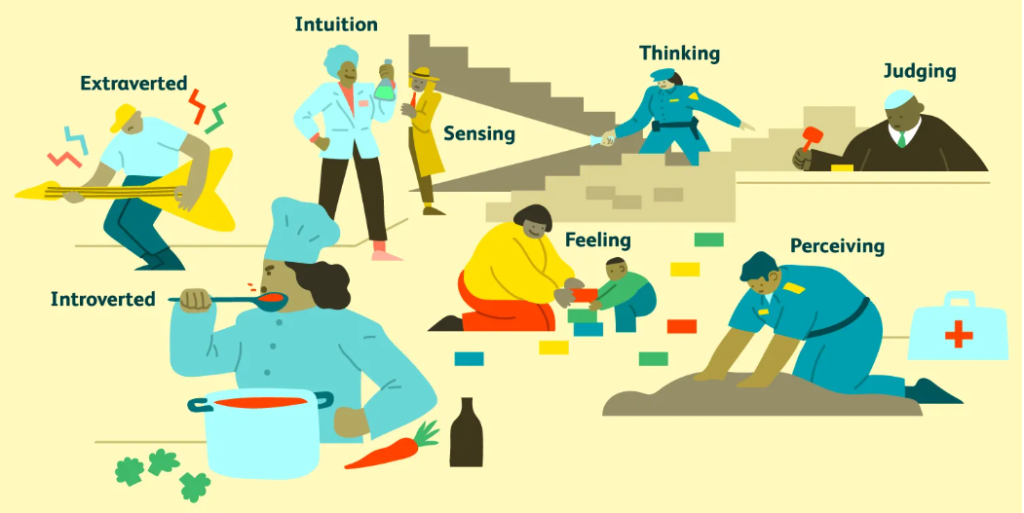
Extraversion (E) – Introversion (I)
Jung first explored the extraversion–introversion dichotomy in his theory of personality types, which describes how people respond and interact with the world around them. While these terms are familiar to most people, the way in which they are used in the MBTI differs somewhat from their popular usage.
- Extraverts (also often spelled extroverts) are “outward-turning” and tend to be action-oriented, enjoy more frequent social interaction, and feel energized after spending time with other people.1
- Introverts are “inward-turning” and tend to be thought-oriented, enjoy deep and meaningful social interactions, and feel recharged after spending time alone.
We all exhibit extraversion and introversion to some degree, but most of us tend to have an overall preference for one or the other.
Sensing (S) – Intuition (N)
This scale examines how people gather information from the world around them. Just as with extraversion and introversion, everyone spends some time sensing and intuiting, depending on the situation. According to the MBTI, people tend to be dominant in one area or the other.
- People who prefer sensing tend to pay close attention to reality, particularly to what they can learn from their own senses.2 They tend to focus on facts and details and enjoy getting hands-on experience.
- Those who prefer intuition pay closer attention to patterns and impressions.2 They enjoy thinking about possibilities, imagining the future, and abstract theories.
Thinking (T) – Feeling (F)
This scale focuses on how people make decisions based on the information that they gathered from their sensing or intuition functions.3
- People who prefer thinking place a greater emphasis on facts and objective data. They tend to be consistent, logical, and impersonal when making decisions.
- Those who prefer feeling are more likely to consider people and emotions when arriving at a conclusion.
Judging (J) – Perceiving (P)
The final scale involves how people tend to deal with the outside world.
- Those who lean toward judging prefer structure and firm decisions.
- People who lean toward perceiving are more open, flexible, and adaptable. These two tendencies interact with the other scales.
Remember, everyone spends at least some time engaged in extraverted activities. The judging-perceiving scale helps describe whether you behave like an extravert when you are taking in new information (sensing and intuiting) or when you are making decisions (thinking and feeling).
The 16 Myers-Briggs Types
Each type is then listed by its four-letter code:
- ISTJ – The Inspector: Reserved and practical, they tend to be loyal, orderly, and traditional.
- ISTP – The Crafter: Highly independent, they enjoy new experiences that provide first-hand learning.
- ISFJ – The Protector: Warm-hearted and dedicated, they are always ready to protect the people they care about.
- ISFP – The Artist: Easy-going and flexible, they tend to be reserved and artistic.
- INFJ – The Advocate: Creative and analytical, they are considered one of the rarest Myers-Briggs types.4
- INFP – The Mediator: Idealistic with high values, they strive to make the world a better place.
- INTJ – The Architect: Highly logical, they are both very creative and analytical.5
- INTP – The Thinker: Quiet and introverted, they are known for having a rich inner world.
- ESTP – The Persuader: Outgoing and dramatic, they enjoy spending time with others and focusing on the here and now.
- ESTJ – The Director: Assertive and rule-oriented, they have high principles and a tendency to take charge.
- ESFP – The Performer: Outgoing and spontaneous, they enjoy taking center stage.
- ESFJ – The Caregiver: Soft-hearted and outgoing, they tend to believe the best of others.
- ENFP – The Champion: Charismatic and energetic, they enjoy situations where they can put their creativity to work.
- ENFJ – The Giver: Loyal and sensitive, they are known for being understanding and generous.
- ENTP – The Debater: Highly inventive, they love being surrounded by ideas and tend to start many projects (but may struggle to finish them).
- ENTJ – The Commander: Outspoken and confident, they excel at planning and organizing projects.
Taking the Myers-Briggs Type Indicator can provide a lot of insight into your personality, which is probably why the instrument has become so popular. Even without taking the formal questionnaire, you can probably immediately recognize some of these tendencies in yourself.
According to the Myers & Briggs Foundation, it is important to remember that every type has value.
When working in group situations in school or at work, for example, recognizing your own strengths and understanding the strengths of others can be very helpful. When you are working toward completing a project with other members of a group, you might realize that certain members of the group are skilled and talented at performing particular actions. By recognizing these differences, the group can better assign tasks and work together on achieving their goals.
How MBTI Compares to Other Tests
The MBTI is just one approach to personality typing. Personality typing refers to systems that categorize people based on their traits, tendencies, and other characteristics. Other popular types of personality tests include:
- The Enneagram
- The Five Love Languages
- The Big Five Personality Assessment
- The Workplace DISC Test
- Cattell’s 16 Personality Factor Questionnaire
However, the Myers-Briggs types differ in some important ways. First, the MBTI is not really a “test.” There are no right or wrong answers, and one type is not better than any other type. The purpose of the indicator is not to evaluate mental health or offer any type of diagnosis.
Also, unlike many other psychological evaluations, your results are not compared against any norms. Instead of looking at your score in comparison to other people’s results, the instrument’s goal is to simply offer further information about your unique personality.
The History of the Myers-Briggs Type Indicator
Both Myers and Briggs were fascinated by Jung’s theory of psychological types and recognized its real-world applications. During World War II, they began researching and developing an indicator to help understand individual differences.6
By helping people understand themselves, Myers and Briggs believed that they could help people select occupations that were best suited to their personality types and lead healthier, happier lives.
Myers created the first pen-and-pencil version of the inventory during the 1940s, and the two women began testing the assessment on friends and family. They continued to fully develop the instrument over the next two decades.7
Is the MBTI a Reliable and Valid Test?
According to the Myers & Briggs Foundation, the MBTI meets accepted standards of reliability and validity. The official website for the test suggests that it has a 90% accuracy and test-retest reliability rating. One older study found that while the scale showed strong internal consistency and test-retest reliability, variations were observed.8
Other studies indicate that the instrument’s reliability and validity have not been adequately demonstrated. For example, some research suggests that many people get different results when they retake the test later, and that the test is not a good predictor of success in different careers.9
While the MBTI remains a popular assessment, there is not enough evidence for its scientific validity to recommend using it as a personality or career guidance tool.
How the MBTI Is Used Today
Because the Myers-Briggs Personality Type Indicator is relatively easy to use, it has become one of the most popular psychological instruments currently in use today. Approximately two million U.S. adults complete the inventory each year.
While there are many versions of the MBTI available online, it should be noted that any of the informal questionnaires that you may find on the Internet are only approximations of the real thing.
The real MBTI must be administered by a trained and qualified practitioner and should include a follow-up of the results. Today, the questionnaire can be administered online via the instrument publisher, CPP, Inc., and includes receiving a professional interpretation of your results.
The current version of the Myers-Briggs Type Indicator includes 93 forced-choice questions in the North American version and 88 forced-choice questions in the European version. For each question, there are two different options from which the respondent must choose.10
Read more:
10 Sources
By Kendra Cherry, MSEd
Kendra Cherry, MS, is a psychosocial rehabilitation specialist, psychology educator, and author of the “Everything Psychology Book.”